For Islamic schools, hifz academies and mosque programs
Islamic Studies Curriculum for Schools: FISLI, the Al-Azhar-governed classical sequence for grades 6 to 12
Your students already have access to Islamic content. What they need is a curriculum that builds on itself, fits together, and produces a graduate who understands what she believes and how we know it. FISLI is that curriculum: five disciplines, 80 units, 240 lessons, every claim traced to a named classical source, reviewed under a four-gate scholarly audit, with teacher guides, assessments and a teacher certification standard. Licenses from $2,500 a year, zakat-eligible.
The problem with most Islamic school curricula
Most Islamic education in North America starts with behavior: rules, halal and haram lists, memorization without context. Students graduate without knowing how we know what we know in this tradition, without knowing what Sunni theology actually claims or why, and without the tools to defend their faith when it is challenged in college or online. The solution is not more Islamic content. It is a different theory of what education is, one the classical tradition has had for fourteen centuries. The word at the center of it is taʾdīb: the formation of persons who know where things belong and place themselves accordingly.
Who it is for
| Setting | How FISLI runs there | Start here |
|---|---|---|
| Full-time Islamic school | One discipline per year across grades 6–12, or two in parallel with daily periods; teacher guides, assessments, scope and sequence for your handbook | Licensing |
| Weekend maktab or mosque program | One discipline a year at one lesson a week; the 56-week Salmān al-Fārisī track for adult new Muslims | Talk to us |
| Hifz academy | FISLI as the Islamic Studies strand beside memorization, starting with ʿUlūm al-Qurʾān so students understand the Book they carry | Talk to us |
| Homeschool family | One unit a month with the family planner; the Sīrah Year at Home | Homeschool |
Scope and sequence
Five disciplines, taught in this order, each in a middle-school and a high-school band of eight units. The complete unit-by-unit map is on the scope and sequence page, free to download as PDF or spreadsheet.
| # | Discipline | Middle School, grades 6–8 (units 1 → 8) | High School, grades 9–12 (units 1 → 8) |
|---|---|---|---|
| 1 | Prophetic Sīrah | The World That Was Waiting → The Miracles, Death, and Eternal Presence | Before the Revelation → The Miracles, Death, and Eternal Presence of the Prophet ﷺ |
| 2 | ʿAqīdah | What Is ʿAqīdah? → The Unseen and the Last Day | What Is ʿAqīdah? → The Unseen and the Last Day |
| 3 | ʿUlūm al-Qurʾān | The Book That Speaks → Living With the Book | The Book That Speaks → Living With the Book |
| 4 | Ḥadīth Sciences | What Is Ḥadīth? → Ḥadīth in Practice | What Is Ḥadīth? → Ḥadīth in Practice |
| 5 | Manṭiq | What Is Logic? → Logic in Service of Dīn | What Is Logic? → Logic in Service of Dīn |
Prophetic Sīrah. Eight units, eight phases of a life. Students meet the Prophet ﷺ before they study revelation. Primary source: Ibn Hishām, with the two Ṣaḥīḥs; every report labelled by the kind of witness it is. Three illustrated films carry Unit 1, Lesson 3.
ʿAqīdah. Classical Sunni theology from al-Sanūsī and al-Nasafī: not a memorization list but a coherent picture a student can explain and build a life on.
ʿUlūm al-Qurʾān. How the Qurʾān was revealed, preserved, compiled and read. Most students who have memorized the Qurʾān have never studied it. This discipline changes that.
Ḥadīth sciences. No civilization built anything like the isnād. Students learn not just what the collections contain but why they deserve the authority they carry.
Manṭiq. The tool that makes every other discipline intelligible, placed last so the student discovers she has been reasoning all along. From al-Akhḍarī's Sullam and al-Abharī's Īsāghūjī.
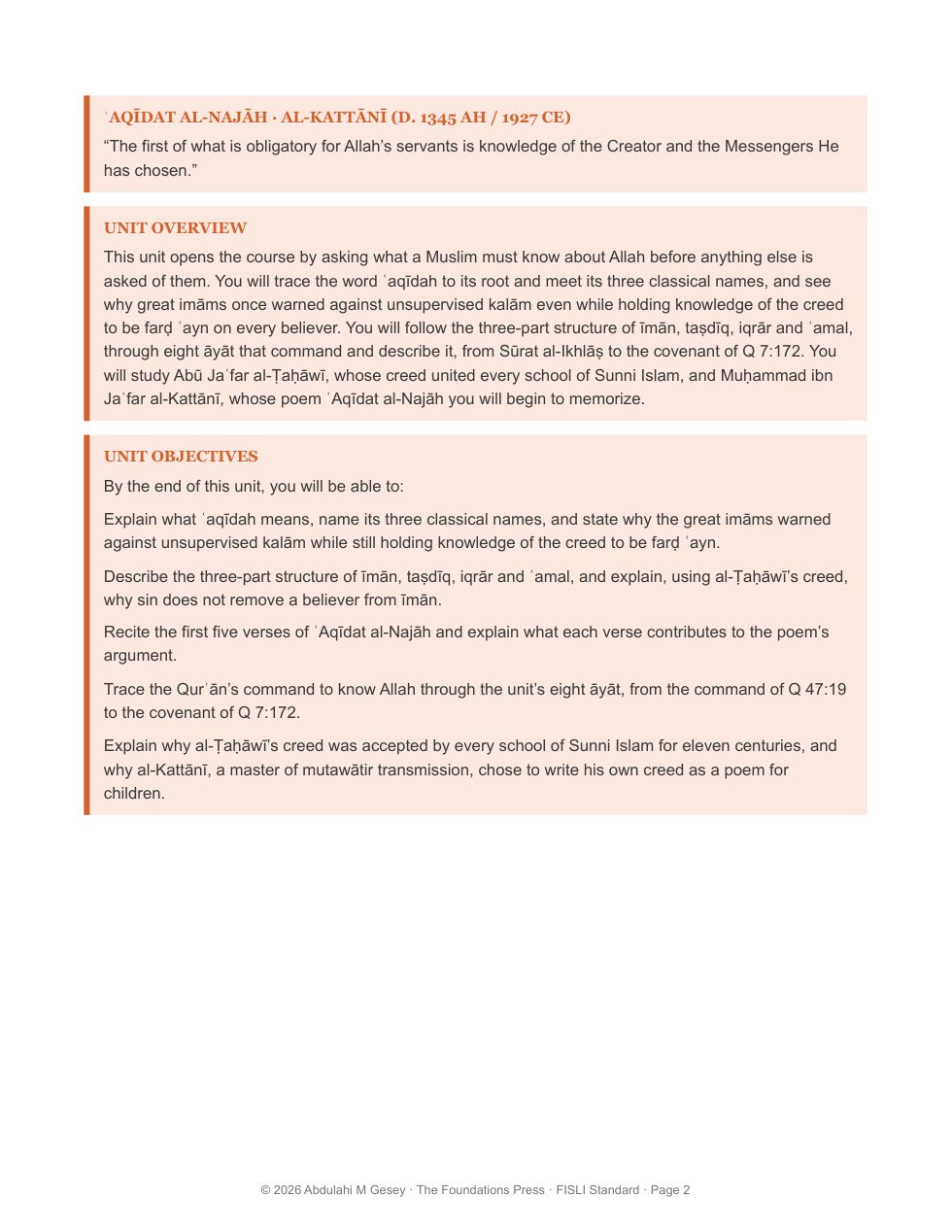
What is in a unit
- Three lessons written for one teacher and 50-minute periods: Read → Reflect → Discuss → Write → Assess.
- Unit overview, objectives, materials, prior-knowledge notes.
- Qurʾānic anchors in Arabic and English with the logical or historical analysis the lesson needs.
- A classical scholar spotlight with the primary text.
- An assessment with a full answer key, and a glossary of Arabic terms with transliteration.
- A source label on every claim. A claim that cannot be traced to a named source through a verified chain is not Islamic knowledge; it is rumor wearing the form of religion.
Scholarly governance you can report to your board
Every unit passes a four-gate audit before it reaches a classroom: source verification, theological review, pedagogical review, and final sign-off. The review board is made up of Al-Azhar-trained scholars holding degrees from Princeton and the University of Chicago, working in the classical Sunni tradition and respecting the four schools of law. Licensing institutions receive the reviewer's name and credentials with every unit, and the governance model is documented in writing: see Al-Azhar governance and the four-gate framework. The texts behind each discipline are listed on the sources page.
Teacher certification is built in
FISLI carries a three-tier transmission standard. Tier 1, Curriculum Authorization, comes with the license and lets any qualified teacher use the materials. Tier 2, FISLI Certified Instructor, is a substantive credential: classical text examination, reviewed and approved by an Azharī scholar. Tier 3, Master Instructor, trains and certifies other teachers. A Tier 2 teacher brings something to the room that a slide deck cannot replicate, and the credential is documented evidence of scholarly oversight for accreditation review. How certification works.
Pricing
| License | Price | Includes |
|---|---|---|
| Annual program license | from $2,500 / year per program | Complete five-discipline curriculum, teacher guides, assessment instruments, Tier 1 authorization for your teachers, onboarding |
| Founding partner bundle | from $3,000 one-time | Permanent license structure and founding attribution in all program documentation; limited slots |
| Large school or Islamic center | $5,000 to $10,000 / year | Multi-program or multi-site license, teacher training and curriculum coaching |
| Mentor formation (community track) | $500 per cohort of 8 | Certified Revert Track Mentor training for the Salmān al-Fārisī program |
| Tailored curriculum commission | $250 deposit | A custom build for a specific tradition, demographic or formation goal |
All purchases are processed through our 501(c)(3) fiscal sponsor and are zakat-eligible for institutional buyers. Purchase orders are accepted. Quebec and Canadian schools: ask for CAD pricing.
How FISLI compares
We checked the publishers that schools most often put beside FISLI, on their own sites and the retailers that stock them, on 20 October 2026. Prices are per book unless stated; none of the others publishes a school licence price.
| FISLI | IQRA | Safar | I Love Islam / ISF | Weekend Learning | Yaqeen curriculum | |
|---|---|---|---|---|---|---|
| Organizing idea | A sequence (taʾdīb): each discipline prepares the next | Topic-based textbooks by grade | Topic-based textbooks by level | Topic-based textbooks by grade | Topic-based workbooks for weekend schools | Thematic units for middle and high school |
| Grades | 6–12 (K–5 in development) | Pre-K–12 | Ages 4–16 | KG–5 (Learning/Living Islam: 6–12) | JK–12 | Middle and high school, as a supplement |
| Ḥadīth sciences and logic taught as disciplines | Yes, both | No | No | No | No | No |
| Named review process | Published four-gate standard, errata page, release register | None named | "Developed with scholars", none named | None named | None named (authors Mansur Ahmad, Husain Nuri) | "Scholar-approved", none named |
| Source labels on claims | Every claim | Selected references | Selected references | Selected references | Selected references | References in units |
| Teacher guides and assessments | Every unit, with answer keys | Teacher manuals; assessments not stated | Teacher guides and exam papers | Teacher guides ($31.99) | Teacher resources; tests in workbooks | Lesson plans and worksheets |
| Teacher certification | Three tiers | No | No | No | No | No |
| Price | License from $2,500 a year; family $197 | About $12.50 per textbook (retailer); no school licence published | £7.49 textbook, £4.59 workbook; 30% institute discount | $34.99 textbook, $7.99 workbook; 10-book set $214.90 | $17 per level | Free |
| Free complete sample unit | Yes | No | No (online platform trial) | No | Contents pages only | Units are free |
Also common: Faith Publications (grades 9–12 only, $124.99 per grade bundle, free sample packet), Darussalam Islamic Studies (grades 1–12, about $24 a book), Goodword (grades 1–10, about $4 a book), Ad-Duha (ages 0–13, workbooks from $5, school licence by application) and Quranic Tarbiyah (ages 5–10, £4 a book, free digital copies). None of them teaches ḥadīth sciences or logic as a subject, and none names its reviewers. Read the longer evaluation framework in How to evaluate an Islamic curriculum.
What happens after you write to us
- A scoping call: your grades, periods per week, teachers, what you use today.
- A sample unit from the discipline you would start with, with the teacher guide.
- A written quote and the license agreement; purchase orders accepted.
- Teacher guides, the scope and sequence and assessment instruments delivered; Tier 1 authorization for your staff.
- A teacher orientation, then your first lesson. Most schools are teaching within four to six weeks.
Request a quote and a sample unit
Questions schools and families ask
What does FISLI cover?
Five disciplines in sequence: Prophetic Sīrah, ʿAqīdah (belief), ʿUlūm al-Qurʾān (Qurʾānic sciences), Ḥadīth sciences, and Manṭiq (classical logic). Level One is 80 units and 240 lessons across a middle-school band (grades 6–8) and a high-school band (grades 9–12). The full unit list is on the scope and sequence page.
What grades is it for?
Grades 6 to 12 today, in two bands written for the age. Elementary units are in development; schools that need K–5 now usually run FISLI for the upper school and keep their existing elementary program.
What does a license cost?
An institutional license starts at $2,500 a year per program and includes the complete five-discipline curriculum, teacher guides and assessment instruments. Founding partner bundles start at $3,000 one-time. Large schools and Islamic centers pay $5,000 to $10,000 a year. Purchases go through our 501(c)(3) fiscal sponsor, so a license is zakat-eligible for institutional buyers.
Who reviews the content?
Every unit passes a four-gate audit (source verification, theological review, pedagogical review, final sign-off) under a scholarly board of Al-Azhar-trained scholars holding degrees from Princeton and the University of Chicago, in the classical Sunni tradition and respecting the four schools of law. Reviewer credentials go to every licensing institution with the units.
How is FISLI different from IQRA, Safar or Weekend Learning?
Those are topic-based textbook series. FISLI is a sequence with a stated theory of formation (taʾdīb), a named governance process, a source label on every claim, and a teacher certification standard. It also teaches two disciplines most programs omit entirely: ḥadīth sciences as a method, and classical logic.
Do our teachers need special training?
No degree is mandated. Tier 1 authorization comes with the license and lets any qualified teacher use the materials; the teacher guides carry the explanation. Tier 2 certification (classical text examination, reviewed by an Azharī scholar) is available for teachers who want a credential that stands up in accreditation review.
Can we see a unit before we talk?
Yes. A complete Manṭiq unit is free to download, and we send a sample from any discipline with a quote. Read it with your Islamic Studies lead and your board before you decide.
Does it work for weekend and hifz programs?
Yes. Mosque weekend programs run one discipline a year at one lesson a week; hifz academies use FISLI as the Islamic Studies strand beside memorization. Distance and international delivery are supported.
How long does onboarding take?
Most schools go from inquiry to first lesson in four to six weeks: a scoping call, a sample unit, the license, teacher guides and the scope and sequence, then a teacher orientation.
Is it accreditation-friendly?
Documented scope and sequence, named scholarly oversight, assessment instruments and a teacher credential are the four things accreditation reviewers ask Islamic Studies departments for. FISLI gives you all four in writing.
Teach one complete lesson of classical logic this week. The free FISLI Manṭiq unit is classroom-ready: three lessons, four Qurʾānic anchors, a scholar spotlight, and an answer key.
Get the free unit