Three-tier transmission standard · online · international
Islamic Studies Teacher Certification (Online): tiers, cost, timeline, how to apply
This is not a teaching credential. It is a transmission standard: three tiers that protect the integrity of the material at the point of delivery, governed by an Azharī scholarly board. A teacher who holds Tier 2 has been examined on the classical texts and approved by a scholar who stands in a chain of transmission from the tradition itself. The classical tradition travels intact, or it does not travel at all.
The three tiers
| Tier | Who it is for | What it requires | What it authorizes | Cost and time |
|---|---|---|---|---|
| Tier 1 · Curriculum Authorization | Any qualified teacher at a licensed school or program | Content-knowledge assessment across the five disciplines; supervised practicum hours | Teaching FISLI units under institutional supervision | Included with the institutional license; 2 to 4 months part-time for candidates with a background |
| Tier 2 · FISLI Certified Instructor | Teachers who want a credential that carries weight in accreditation review | A minimum period of documented FISLI classroom teaching; classical text examination; portfolio review and approval by an Azharī scholar-reviewer | Independent classroom authority; the credential named in accreditation files | Quoted per candidate; cohort rates for schools |
| Tier 3 · Master Instructor | Senior instructors who will train and certify others | Tier 2 in at least three disciplines; a record of Tier 1 candidates mentored; board nomination and approval; Azharī formation background | Training and certifying teachers; directing a community track | By nomination |
The difference between a credential and a transmission standard
A teaching credential certifies that someone knows how to teach. It says nothing about the integrity of what they are teaching. A transmission standard certifies that someone is authorized to transmit a specific intellectual tradition with fidelity: that the material will arrive with students the same way it left the scholars. This distinction matters enormously in Islamic education. A curriculum with a formal teacher certification governed by an Azharī scholarly board is categorically different from a curriculum without one. FISLI teacher certification is the mechanism by which the classical tradition travels intact from Cairo to North America to your classroom.
Who governs it
The Foundations Press scholarly board: Al-Azhar-trained scholars holding degrees from Princeton and the University of Chicago, working in the classical Sunni tradition. The board governs theological compliance, endorses every Tier 2 and Tier 3 credential, and provides the chain of transmission every FISLI unit carries. Tier 2 and 3 are not issued by an administrator; they require scholarly review. A teacher who has lived with Ibn Hishām, who has allowed al-Sullam to form her reasoning, who carries al-Shifāʾ in her understanding of the Prophet ﷺ, brings something to the room that a slide deck cannot replicate.
How to become a certified Islamic Studies teacher
- Confirm eligibility. A foundation in the five FISLI disciplines (Sīrah, ʿAqīdah, Qurʾānic sciences, Ḥadīth sciences, Manṭiq) through prior study, a relevant degree, or FISLI's own bridge coursework. No specific degree is mandated; demonstrated competence is, verified through the intake assessment.
- Apply through your sponsoring school or independently, with a background summary, a statement of teaching intent and, where applicable, a letter from a supervising institution. The form is below.
- Tier 1. Pass the content-knowledge assessment and complete supervised practicum hours. You are now authorized to teach FISLI under institutional supervision.
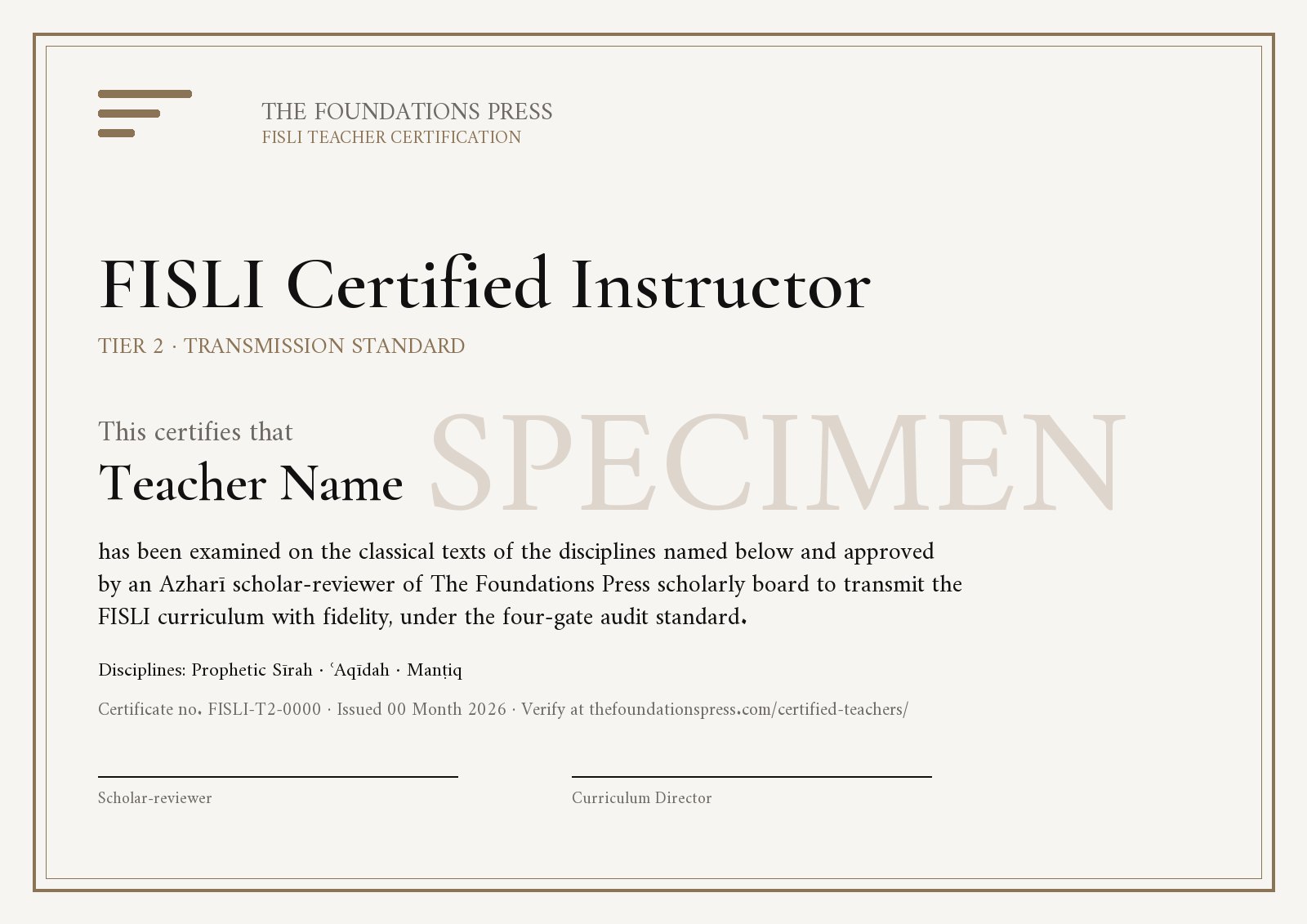
- Tier 2. After a minimum period of documented classroom teaching with FISLI, sit the classical text examination with an Azharī scholar-reviewer and submit your portfolio for board review. The certificate carries a number and appears in the public registry.
- Tier 3. By board nomination, for Tier 2 holders in three or more disciplines with a record of candidates mentored.
Typical timeline. Candidates entering with an existing Islamic Studies background complete Tier 1 within two to four months of part-time work; teachers new to the classical sciences take the bridge coursework first and should plan for a school year.
How it compares with other options
Options an Islamic school teacher in North America can realistically take, from the providers' own pages (October 2026). Each serves a different need.
| Program | What it certifies | Format and length | Published cost | Examined by |
|---|---|---|---|---|
| FISLI Teacher Certification (this page) | Authorization to transmit a specific classical curriculum; three tiers | Online; Tier 1 in 2–4 months part-time | Tier 1 with the license; Tier 2–3 quoted | Azharī scholar-reviewer, scholarly board |
| American Islamic College (Chicago), Certificate in Islamic School Teaching | Professional development for K–12 and weekend-school educators: a core course, Prophetic Leadership, plus four electives (classroom management, curriculum transformation, teaching strategies) | Five courses | $300 per course, $1,200 for the track (aicusa.edu) | Dr. Leila Shatara, Habeeb Quadri; a non-credit PD certificate |
| Rabata, Ribaat Teacher Certification (women, 17+) | Certified Ribaat Teacher: Level 1 then Level 2, courses in Sīrah, the Companions, Arabic, tajwīd and methodology | Online, multi-year | $125 registration; course tuition not published (academy.rabata.org) | Rabata Education Committee; institute led by Dr. Tamara Gray |
| Ribāṭ University (Rabata), Certificate in Teaching Islam | Post-baccalaureate certificate, 26 credit hours | Admissions open November 2026 | About $150 per credit; $35 application (ribat.rabata.org) | Not named on the page |
| Mishkah University | No teacher-training program; the nearest course is Islamic Pedagogy and Khaṭāba (3 credits) | Online, one semester | $100 per credit, $300 for the course (mishkahu.com) | Ust. Ibrahim Hafidh |
| ISNA Education Forum; ISLA workshops; CISNA PD | Conference sessions and webinars for Islamic school staff; CISNA's 10-month Leadership Institute for administrators | In person (ISNA, April) and online (ISLA monthly) | ISNA Forum $185; ISLA ticketed, price not published; CISNA by request | Practitioners; PD-hour status not published |
| Adelaide University, Graduate Certificate in Education (Islamic Education) | Accredited graduate certificate; pathway to MEd and PhD | Online; half a year full-time | AUD 11,000 domestic; AUD 21,700 international (adelaideuni.edu.au) | University faculty |
| University of Warwick, PGA Islamic Education | Postgraduate award, upgradable to the MA in Islamic Education | Online or on campus; 10 weeks | £2,175 home; £4,890 overseas (warwick.ac.uk) | University faculty |
Figures were read from the providers' own pages on 20 October 2026 (AIC's from its bulletin and search listings, since its site refused automated requests); confirm before enrolling. If you need pedagogy hours, AIC, ISLA and the ISNA Education Forum are the right places. If you need an accredited university award, Adelaide and Warwick offer them at university prices. If you need a credential that says what you teach is the classical tradition, intact, examined by a scholar, that is what FISLI certifies.
Apply
Questions schools and families ask
What is FISLI teacher certification?
A three-tier transmission standard governed by The Foundations Press scholarly board: Tier 1 Curriculum Authorization, Tier 2 FISLI Certified Instructor, Tier 3 Master Instructor. It certifies that a teacher is authorized to transmit the FISLI curriculum with fidelity.
What does it cost?
Tier 1 authorization comes with an institutional license. Tier 2 and Tier 3 are quoted per candidate with the application; a school certifying several teachers at once receives a cohort rate. Mentor formation for the community track is $500 per cohort of eight.
How long does it take?
Candidates with an existing Islamic Studies background typically complete Tier 1 within two to four months part-time. Tier 2 follows a minimum period of documented classroom teaching with FISLI and a portfolio review; Tier 3 is by board nomination.
Is it online?
Yes. Coursework, the intake assessment and the portfolio review are remote; the classical text examination for Tier 2 is a live session with the scholar-reviewer. International candidates are welcome.
Does it count for PD hours or accreditation?
Certification documents are written so a school can present them to accreditation reviewers as evidence of scholarly oversight in the Islamic Studies department. Ask your accreditor about professional-development hours; we provide the hour counts for each tier.
Do I need a degree?
No specific university degree is mandated. What is mandated is demonstrated competence in the five disciplines, verified through the intake assessment or FISLI's bridge coursework.
Who examines Tier 2 candidates?
An Azharī scholar-reviewer on The Foundations Press scholarly board, which is made up of Al-Azhar-trained scholars holding degrees from Princeton and the University of Chicago.
Can I verify a certificate?
Yes. Every Tier 2 and Tier 3 certificate carries a number; the public registry lists holders, and you can write to us with the number to confirm it.
See what a certified teacher teaches. The free FISLI Manṭiq unit is classroom-ready: three lessons, four Qurʾānic anchors, a scholar spotlight, and an answer key.
Get the free unit