For new Muslims · 56 weeks · halaqa and online
New Muslim Course Online for Converts: the 56-week Salmān al-Fārisī Formation Track
Every mosque that welcomes new Muslims faces the same problem: the convert takes the shahāda, attends a few introductory classes, and then, what? Introductory programs cover the pillars, the articles of faith and halal and haram. None of them give what classical formation requires: a sequenced, coherent encounter with the whole intellectual architecture of the tradition. This track does, from the shahāda to intellectual confidence, in 56 weeks.
Join the waitlist Start with a free unit
What you will learn, week by week
The same five FISLI disciplines, resequenced for where an adult convert's understanding actually begins. Two semesters of 28 weeks; 90 minutes a week; four to eight participants with a mentor.
The 56-week syllabus
| Week | Unit | What happens |
|---|---|---|
| 1–2 | Orientation | How the track works; the adab of learning; your mentor and your halaqa; what "I believe" will mean by week 56. |
| 3 | Prophetic Sīrah · The World That Was Waiting | Meet him ﷺ as a person before any doctrine: read, reflect, discuss. |
| 4 | Prophetic Sīrah · Why We Study Sīrah | Meet him ﷺ as a person before any doctrine: read, reflect, discuss. |
| 5 | Prophetic Sīrah · The Mission Begins | Meet him ﷺ as a person before any doctrine: read, reflect, discuss. |
| 6 | Prophetic Sīrah · Persecution, Patience, and the Two Ḥijrahs | Meet him ﷺ as a person before any doctrine: read, reflect, discuss. |
| 7 | Prophetic Sīrah · The Prophet’s Household | Meet him ﷺ as a person before any doctrine: read, reflect, discuss. |
| 8 | Prophetic Sīrah · The Madīnan Period | Meet him ﷺ as a person before any doctrine: read, reflect, discuss. |
| 9 | Prophetic Sīrah · The Prophet ﷺ as a Person | Meet him ﷺ as a person before any doctrine: read, reflect, discuss. |
| 10 | Prophetic Sīrah · The Miracles, Death, and Eternal Presence | Meet him ﷺ as a person before any doctrine: read, reflect, discuss. |
| 11–14 | Prophetic Sīrah · review and discussion | Assessment with key; one open question per participant; mentor feedback. |
| 15 | ʿAqīdah · What Is ʿAqīdah? | What Muslims believe and why, from al-Sanūsī and al-Nasafī, with the proofs. |
| 16 | ʿAqīdah · The Proof for Allah’s Existence | What Muslims believe and why, from al-Sanūsī and al-Nasafī, with the proofs. |
| 17 | ʿAqīdah · The Necessary Attributes, Part One | What Muslims believe and why, from al-Sanūsī and al-Nasafī, with the proofs. |
| 18 | ʿAqīdah · The Necessary Attributes, Part Two | What Muslims believe and why, from al-Sanūsī and al-Nasafī, with the proofs. |
| 19 | ʿAqīdah · The Beautiful Names | What Muslims believe and why, from al-Sanūsī and al-Nasafī, with the proofs. |
| 20 | ʿAqīdah · Prophethood | What Muslims believe and why, from al-Sanūsī and al-Nasafī, with the proofs. |
| 21 | ʿAqīdah · The Seal of the Prophets | What Muslims believe and why, from al-Sanūsī and al-Nasafī, with the proofs. |
| 22 | ʿAqīdah · The Unseen and the Last Day | What Muslims believe and why, from al-Sanūsī and al-Nasafī, with the proofs. |
| 23–26 | ʿAqīdah · review and discussion | Assessment with key; one open question per participant; mentor feedback. |
| 27–28 | Mid-year | Semester review; a written reflection; the second semester plan. |
| 29 | ʿUlūm al-Qurʾān · The Book That Speaks | How the Book came down, was kept and is read; how to approach it as a text. |
| 30 | ʿUlūm al-Qurʾān · How It Came Down | How the Book came down, was kept and is read; how to approach it as a text. |
| 31 | ʿUlūm al-Qurʾān · How It Was Kept | How the Book came down, was kept and is read; how to approach it as a text. |
| 32 | ʿUlūm al-Qurʾān · The Unbroken Multitude | How the Book came down, was kept and is read; how to approach it as a text. |
| 33 | ʿUlūm al-Qurʾān · The Seven Ways | How the Book came down, was kept and is read; how to approach it as a text. |
| 34 | ʿUlūm al-Qurʾān · The Qurʾān Reads Itself | How the Book came down, was kept and is read; how to approach it as a text. |
| 35 | ʿUlūm al-Qurʾān · Who May Speak for the Book | How the Book came down, was kept and is read; how to approach it as a text. |
| 36 | ʿUlūm al-Qurʾān · Living With the Book | How the Book came down, was kept and is read; how to approach it as a text. |
| 37–38 | ʿUlūm al-Qurʾān · review and discussion | Assessment with key; one open question per participant; mentor feedback. |
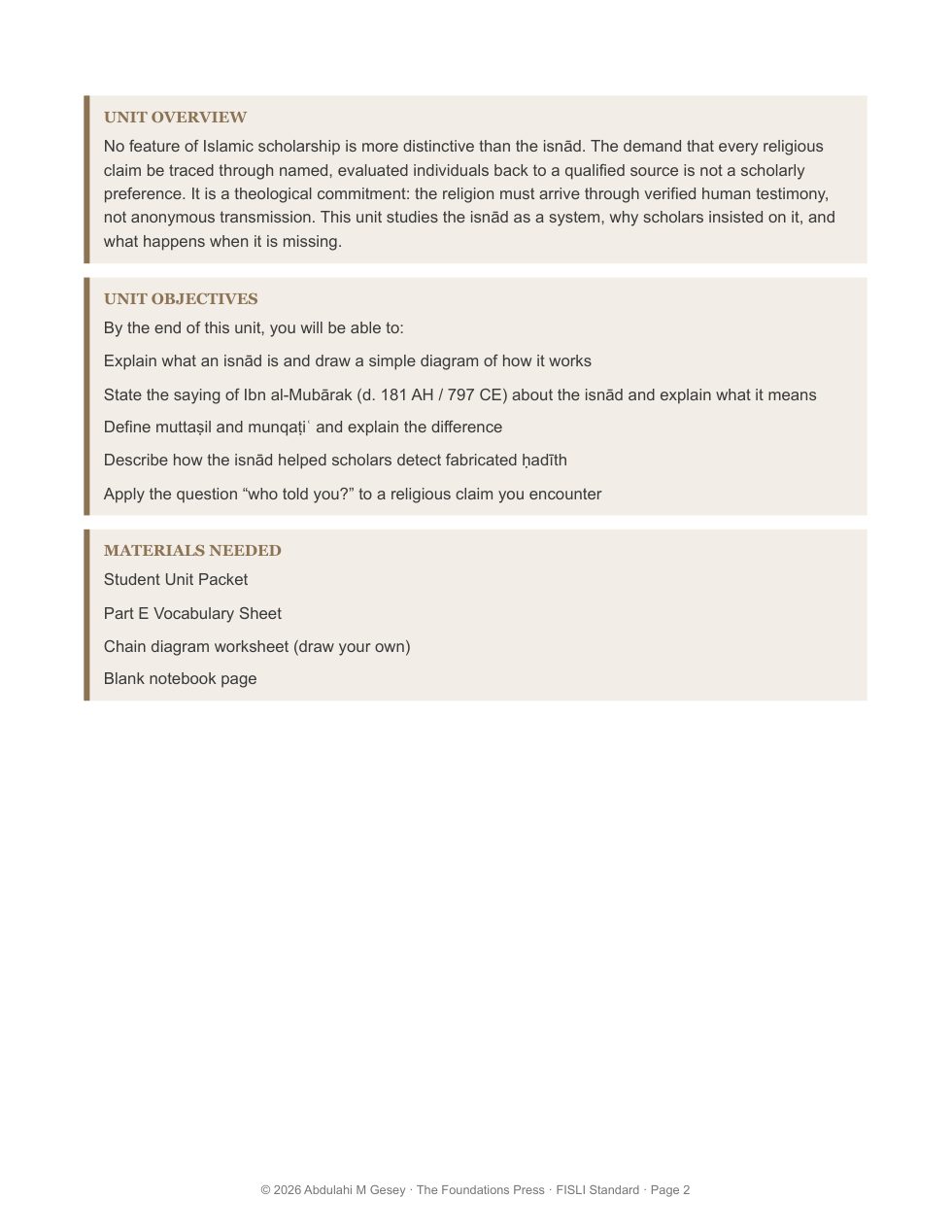
| 39 | Ḥadīth Sciences · What Is Ḥadīth? | The isnād as a way of thinking about evidence; how a ḥadīth is weighed. |
| 40 | Ḥadīth Sciences · The Companions as Witnesses | The isnād as a way of thinking about evidence; how a ḥadīth is weighed. |
| 41 | Ḥadīth Sciences · The Isnād | The isnād as a way of thinking about evidence; how a ḥadīth is weighed. |
| 42 | Ḥadīth Sciences · The Science of Rijāl | The isnād as a way of thinking about evidence; how a ḥadīth is weighed. |
| 43 | Ḥadīth Sciences · Categories of Ḥadīth | The isnād as a way of thinking about evidence; how a ḥadīth is weighed. |
| 44 | Ḥadīth Sciences · The Major Collections | The isnād as a way of thinking about evidence; how a ḥadīth is weighed. |
| 45 | Ḥadīth Sciences · Al-Muwaṭṭaʾ | The isnād as a way of thinking about evidence; how a ḥadīth is weighed. |
| 46 | Ḥadīth Sciences · Ḥadīth in Practice | The isnād as a way of thinking about evidence; how a ḥadīth is weighed. |
| 47–48 | Ḥadīth Sciences · review and discussion | Assessment with key; one open question per participant; mentor feedback. |
| 49 | Manṭiq · What Is Logic? | Correct reasoning, named at last: you have been doing it all year. |
| 50 | Manṭiq · The Concept and Definition | Correct reasoning, named at last: you have been doing it all year. |
| 51 | Manṭiq · The Five Universals | Correct reasoning, named at last: you have been doing it all year. |
| 52 | Manṭiq · The Proposition | Correct reasoning, named at last: you have been doing it all year. |
| 53 | Manṭiq · The Syllogism | Correct reasoning, named at last: you have been doing it all year. |
| 54 | Manṭiq · Induction and Analogy | Correct reasoning, named at last: you have been doing it all year. |
| 55 | Manṭiq · Fallacies | Correct reasoning, named at last: you have been doing it all year. |
| 56 | Manṭiq · Logic in Service of Dīn | Correct reasoning, named at last: you have been doing it all year. |
| 57–56 | Manṭiq · review and discussion | Assessment with key; one open question per participant; mentor feedback. |
| 57–56 | Capstone | Your own account of what you believe and how you know it; completion; the mentor pathway. |
How classes work
A halaqa: small enough for real conversation, large enough for community. Each week you read the lesson, reflect on its Qurʾānic anchor, discuss the two questions, and write. Once a unit, a short assessment with an answer key tells you and your mentor what landed. Your mentor is a Certified Revert Track Mentor, trained by The Foundations Press. Everything is in English; Arabic is transliterated and explained.
Cost and how to join
Mosques license the track for their communities; most participants pay nothing or a small materials fee set by the mosque. If your community does not run it yet, join the waitlist: we will connect you to a participating community or an online cohort, or help your mosque license it. The mosque licensing page has the institutional details.
Join the waitlist
Meet the mentors
Certified Revert Track Mentors are graduates of the track or FISLI-certified teachers who have completed mentor formation. Every mentor teaches from the facilitator guide and under the scholarly board's review. Mentor profiles are added to this page as cohorts open.
How it compares with other courses for new Muslims
Most of what exists online for converts is an introduction: the pillars, the articles of faith, how to pray. All of it is good, and some of it is free and excellent. None of it is a 56-week sequence through the five sciences with a mentor. Checked on the providers' pages, 20 October 2026.
| Course | Shape | Length | Cost | Teacher named |
|---|---|---|---|---|
| Salmān al-Fārisī Track (this page) | Five disciplines in sequence; halaqa of 4–8 with a certified mentor; assessments | 56 weeks | Through mosques; usually free or a materials fee | Mentors listed as cohorts open |
| New Muslim Academy | Video classes, webinars, 1:1 consultation, mentorship, certificates | Not published | Free | No |
| SeekersGuidance, Absolute Essentials of Islam | Belief and practice at level one (Ḥanafī and Shāfiʿī versions) | 12–14 lessons, about 7 hours | Free | Yes (Shaykh Faraz Rabbani) |
| Embrace (ICNA), Islam: Step by Step | Fundamentals class in a cohort, plus weekly convert-led halaqas | 14 weekly sessions | Not published | No |
| Yaqeen Institute, Conviction Circles and convert resources | Peer-led discussion kits and videos | Self-paced | Free | Facilitator-led |
| International Open University, New Muslim Certificate | "The First Day", "The First Week": essentials of practice | Self-paced | Subscription, about $1–11 a month | No |
| AlQuranDesk, New Muslim Course | Tutoring: beliefs, pillars, wuḍūʾ and prayer, Qurʾān reading | Not published | Plans from about $40 a month | No |
Take the free introductions first if you have not: SeekersGuidance's essentials and Yaqeen's pillars series are sound. Then come here for the architecture.
Why Salmān al-Fārisī?
Salmān was born in Persia and spent decades searching for truth, from Zoroastrianism through Christianity, guided by scholars who pointed him toward the Prophet ﷺ. His story is the story of intellectual formation: a person who did not stop until he found the whole architecture of what he believed, and then gave everything to it. The track asks that of every participant: not to accept Islam as a list to memorize, but to understand it as the tradition that carries it.
Questions schools and families ask
Who is this for?
Adult new Muslims who have taken the shahāda and want the full intellectual architecture behind what they believe, not another introductory class. Also for people seriously exploring Islam who want to study it the way Muslims study it.
Is it free?
The free Manṭiq unit and the syllabus on this page are free. The 56-week track runs through mosques, which license it for their communities; participants usually pay nothing or a small materials fee set by the mosque. Join the waitlist and we will connect you to a participating community, or help your mosque license it.
How is it taught?
In a halaqa of four to eight participants, 90 minutes a week, facilitated by a Certified Revert Track Mentor, for two semesters of 28 weeks. Where no local community runs it, cohorts meet online.
Do I need Arabic?
No. Everything is in English with Arabic terms transliterated and explained. You will meet the Qurʾān in Arabic with translation beside it.
What will I be able to do at the end?
Explain what Sunni theology claims and why; tell a sound report from a weak one; read a Qurʾānic passage with its context; name a bad argument when you hear one. Graduates are eligible for the mentor pathway.
Why is it named after Salmān al-Fārisī?
He was the first famous convert in Islamic history: a Persian who searched for decades, through Zoroastrianism and Christianity, until scholars pointed him to the Prophet ﷺ. The track asks the same of you: not a list to memorize, but a tradition to understand.
Can my mosque run it?
Yes. The license includes the 56-week curriculum, facilitator guides, the Formation Assessment Kit for intake and mentor training ($500 per cohort of eight mentors). International communities are welcome.
How do I start today?
Download the free unit, read the syllabus below, and join the waitlist. We reply within two business days.
Read one lesson today. The free FISLI Manṭiq unit is classroom-ready: three lessons, four Qurʾānic anchors, a scholar spotlight, and an answer key.
Get the free unit