Free download · CC BY 4.0
FISLI Scope and Sequence: a complete Islamic Studies map for grades 6 to 12
Five disciplines, two bands, 80 units, 240 lessons, in the order the classical tradition taught them. Use it to plan your own Islamic Studies program, to audit a curriculum you already run, or to see exactly what a FISLI license contains. Download it as a PDF or a spreadsheet; share it with attribution.
Download the PDF Download the spreadsheet (CSV)
Why the order matters
Most Islamic Studies programs are a list of topics. FISLI is a sequence: each discipline supplies what the next one needs. Students meet the Prophet ﷺ as a person before they study belief in the abstract. They learn what Sunni theology claims before they learn how the Qurʾān was preserved. They learn how a ḥadīth is weighed before they learn formal logic. Manṭiq comes last, and a student who reaches it discovers she has been reasoning all year and can now name what she was doing. The principle is taʾdīb, the right placement of things; we explain the word here.
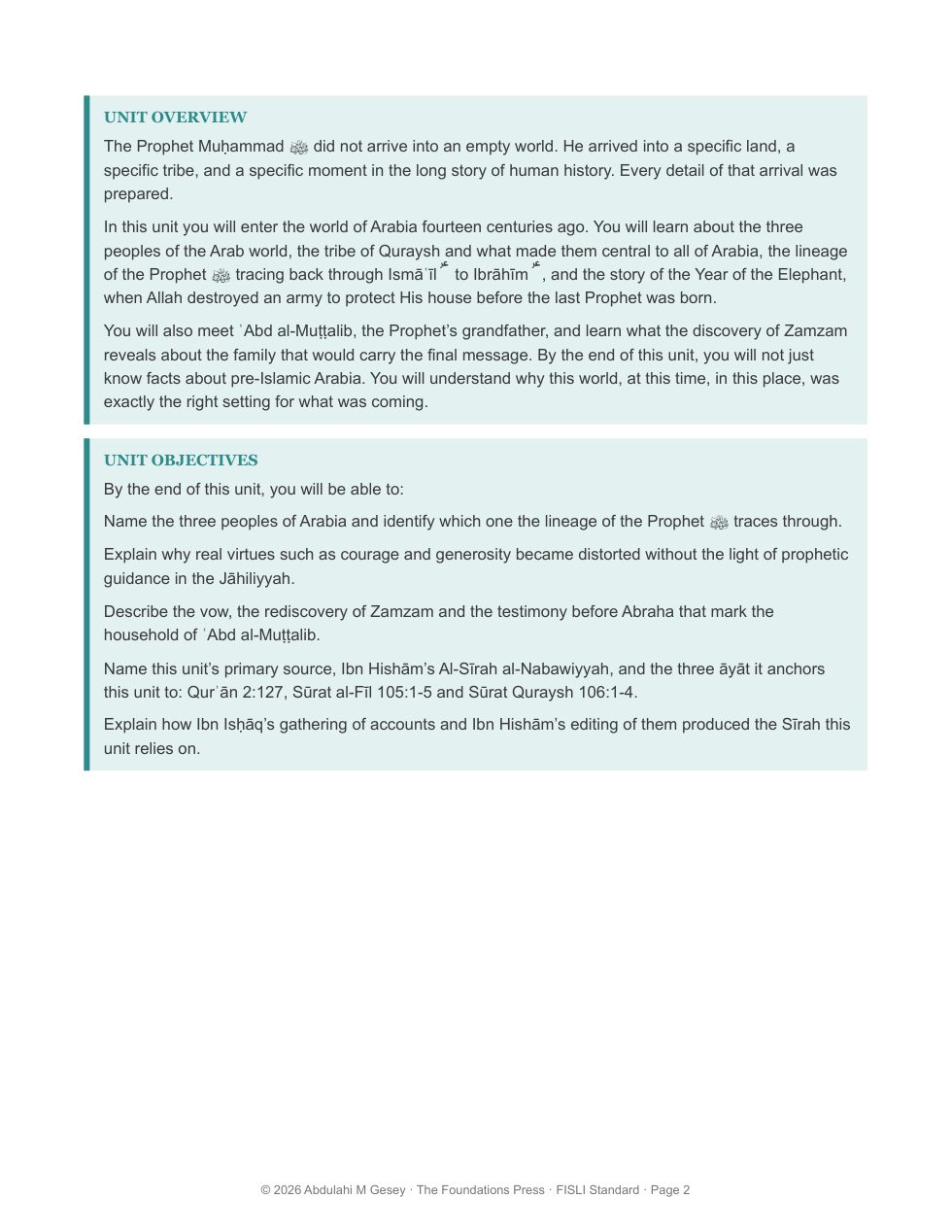
What every unit contains
- Three lessons, each built as Read → Reflect → Discuss → Write → Assess, written for one instructor and 50-minute periods.
- A unit overview and measurable objectives.
- Materials, prior-knowledge notes, and the Qurʾānic anchors in Arabic and English.
- A classical scholar spotlight with the primary text the unit rests on.
- An assessment with a full answer key, and a glossary of the Arabic terms.
- A source label on every claim: the Qurʾān, a ṣaḥīḥ ḥadīth, a Companion's report, a historian without a chain, a scholar's reasoning, or a weak chain.
1. Prophetic Sīrah
| Unit | Middle School (grades 6–8) | High School (grades 9–12) |
|---|---|---|
| 1 | The World That Was Waiting | Before the Revelation |
| 2 | Why We Study Sīrah | Why We Study Sīrah |
| 3 | The Mission Begins | The Mission Begins |
| 4 | Persecution, Patience, and the Two Ḥijrahs | Persecution, Patience, and the Two Hijrahs |
| 5 | The Prophet’s Household | The Prophet’s ﷺ Household |
| 6 | The Madīnan Period | The Madīnan Period |
| 7 | The Prophet ﷺ as a Person | The Prophet ﷺ as a Person |
| 8 | The Miracles, Death, and Eternal Presence | The Miracles, Death, and Eternal Presence of the Prophet ﷺ |
2. ʿAqīdah
| Unit | Middle School (grades 6–8) | High School (grades 9–12) |
|---|---|---|
| 1 | What Is ʿAqīdah? | What Is ʿAqīdah? |
| 2 | The Proof for Allah’s Existence | The Proof for Allah’s Existence |
| 3 | The Necessary Attributes, Part One | The Necessary Attributes, Part One |
| 4 | The Necessary Attributes, Part Two | The Necessary Attributes, Part Two |
| 5 | The Beautiful Names | The Beautiful Names |
| 6 | Prophethood | Prophethood |
| 7 | The Seal of the Prophets | The Seal of the Prophets |
| 8 | The Unseen and the Last Day | The Unseen and the Last Day |
3. ʿUlūm al-Qurʾān
| Unit | Middle School (grades 6–8) | High School (grades 9–12) |
|---|---|---|
| 1 | The Book That Speaks | The Book That Speaks |
| 2 | How It Came Down | How It Came Down |
| 3 | How It Was Kept | How It Was Kept |
| 4 | The Unbroken Multitude | The Unbroken Multitude |
| 5 | The Seven Ways | The Seven Ways |
| 6 | The Qurʾān Reads Itself | The Qurʾān Reads Itself |
| 7 | Who May Speak for the Book | Who May Speak for the Book |
| 8 | Living With the Book | Living With the Book |
4. Ḥadīth Sciences
| Unit | Middle School (grades 6–8) | High School (grades 9–12) |
|---|---|---|
| 1 | What Is Ḥadīth? | What Is Ḥadīth? |
| 2 | The Companions as Witnesses | The Companions as Witnesses |
| 3 | The Isnād | The Isnād |
| 4 | The Science of Rijāl | The Science of Rijāl |
| 5 | Categories of Ḥadīth | Categories of Ḥadīth |
| 6 | The Major Collections | The Major Collections |
| 7 | Al-Muwaṭṭaʾ | Al-Muwaṭṭaʾ |
| 8 | Ḥadīth in Practice | Ḥadīth in Practice |
5. Manṭiq
| Unit | Middle School (grades 6–8) | High School (grades 9–12) |
|---|---|---|
| 1 | What Is Logic? | What Is Logic? (in draft) |
| 2 | The Concept and Definition | The Concept and Definition |
| 3 | The Five Universals | The Five Universals (in draft) |
| 4 | The Proposition | The Proposition |
| 5 | The Syllogism | The Syllogism (in draft) |
| 6 | Induction and Analogy | Induction and Analogy |
| 7 | Fallacies | Fallacies |
| 8 | Logic in Service of Dīn | Logic in Service of Dīn |
Pacing
One discipline per year in a school with two Islamic Studies periods a week fills a six-year program from grade 6 to grade 12 with a year to spare for review and capstones. A school with daily Islamic Studies can run two disciplines in parallel. Homeschool families usually run one unit a month, three lessons and a review week: see the 36-week Sīrah Year planner.
Use it freely
This scope and sequence is published under CC BY 4.0: copy it into your handbook, adapt it, print it for your board, as long as you credit The Foundations Press and link to this page. The units themselves are licensed to schools and mosque programs and to families; one complete unit is free to download so you can judge the standard before you ask for a quote.
Teach one complete lesson of classical logic this week. The free FISLI Manṭiq unit is classroom-ready: three lessons, four Qurʾānic anchors, a scholar spotlight, and an answer key.
Get the free unit